
A quick, carefully controlled injection that delivers medicine into the eye to treat swelling and abnormal blood vessels in the retina.
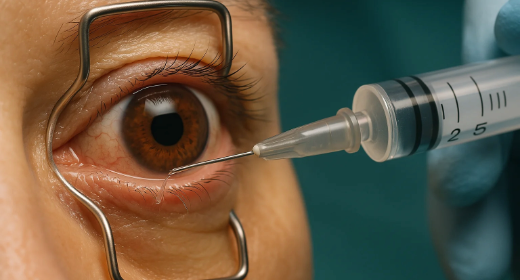 Injection site
Medicine goes into the gel inside the eye
An intravitreal injection places medicine directly into the vitreous, the clear gel that fills the inside of the eye.
The medicine reaches the retina at the back of the eye, where it reduces swelling and stops abnormal blood vessels from growing or leaking. Eye drops and tablets cannot reach this area in the same way.
Injections are usually given as a course, often monthly at first, then spaced out as the eye responds.
At a glance
Injections treat retinal conditions that often cause these symptoms:
Reading and recognising faces becomes harder.
Straight lines look wavy or bent.
Fluid builds up in the centre of the retina.
A blank or dark patch in central vision.
New glasses do not help.
Colours appear washed out.
Injections are recommended when scans show fluid, swelling or abnormal blood vessels in the macula. Starting treatment early gives the best chance of protecting your vision.
Regular injections are key. Missing treatments can allow swelling to return and vision to drop, so keep to your schedule.
Injections are commonly used for
 Consultant Ophthalmologist
Dr. Waleed Bunami
Meet the team
Every injection is given with strict cleaning and sterile equipment.
A very fine needle is used and the procedure takes seconds.
Retinal scans guide when you need your next injection.
Injections given by an experienced ophthalmologist.
We check your vision and scan the retina to plan treatment.
Numbing drops are used and the eye is cleaned with antiseptic.
A small clip keeps the eye open and the medicine is injected in a few seconds.
We check your eye pressure, then you go home the same day.
The eye may feel gritty and vision may be blurry. A small red patch can appear.
Floaters from the medicine are common and fade. Use any drops as advised.
Usually in 4–8 weeks, with a scan to decide on further injections.
Gaps between injections are extended as the eye improves.
Do
Avoid
Most people feel only slight pressure. The eye is numbed beforehand and the injection takes a few seconds.
It depends on your condition and how your eye responds. Many people need several injections in the first year.
Increasing pain, redness, light sensitivity or worsening vision in the days after an injection need urgent review.
Please arrange for someone to drive you, as your vision may be blurry for a few hours.
Our ophthalmologist will scan your retina and explain whether injections are right for you.
Sunday to Friday · 9 am – 1 pm, 4 pm – 9 pm